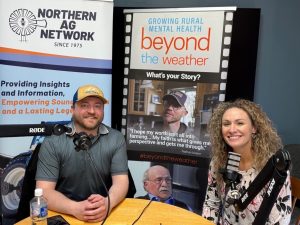
Welcome to Beyond the Weather—where the conversations go deeper than the forecast. This is a place for real stories from rural life… the humor, the challenges and the people that keep us going. Because sometimes, the most important things to talk about are not the easiest things to bring up.
Courtney
Obviously, we can keep talking. So I wanted to get a sense of kind of where you and your family are in place and time. So to start off, tell us where you farm and how you guys got there.
Klayton
So our farm is 20 miles, mostly east and a little south of Shelby, Montana, south of Devon, which is the town I lay claim to on Right, very nice.
Courtney
Very nice.
Klayton
1910. My great-grandpa homesteaded there and the Lore family came from Germany. And as far as I know, the original group, they’re mostly cousins, landed in Pennsylvania and then kind of spread out from there. Some went to kind of Illinois and then down into the like St. Louis region and then some to South Dakota and we landed in north central Montana. Kind of, it’s been cool to catch up a little bit, like Facebook and things of that nature. I’ve had people reach out to me, fellow lors, I guess. And then beyond that, my sister Kelson is going to medical school in Billings and One of the kids she’s going to school with, they showed up for a night out, a group of them, and he had, it was Lord Distributors out of St. Louis, Missouri. Yeah, like a beer.
Courtney
So why didn’t your family end up doing beer and say, look, what are you doing?
Klayton
Maybe if this farming thing doesn’t work out, I’ll go down there and ask for a job.
Courtney
Remember me? I’m your cousin.
Klayton
Run the beer truck around. So that’s awesome. Yeah, that’s. That’s a little bit of how we ended up where we are.
Courtney
And tell us, what is it? I mean, what is it like up there? I always think of that Shelby Cutbank area as just wind is what comes to mind for me, but what is the landscape? What’s the soil like?
Klayton
Yeah, it’s windy all right. I will say the day I snap and go on my grippy sock vacation, it’s going to be a windy day. That’s what’s going to do me. And finally, I think, I mean, in the last three weeks, I think we’ve had 14, 15 days of high wind warnings. So that’s rough.
Courtney
What’s been your worst wind-related claim you’ve had over the years?
Klayton
A few years ago, it blew in the end wall on a large equipment shed.
Courtney
Wow.
Klayton
That was a process. I did say what we ended up doing was instead of fixing the entire wall, we ended up putting a door in that end. So I used the phrase, when God blows down an end wall, it gives you an opportunity to put up a door. So instead of when God closes a door, he opens a window. Well, I went with this. He opened that end ball and we closed it with the door.
Courtney
Right, okay.
Klayton
That was the biggest wind claim thus far, but I’m sure it’s not over yet.
Courtney
Yeah, knock on wood. All right.
Klayton
And then being right north of the Marias River, we have a lot of sandy ground, which doesn’t go well with wind. It’s easy to blow around and That’s pretty tough on a guy’s mental health. I mean, I was gone for the majority of the month of March, going to different conferences and visiting family. When I got home after a couple weeks of those high wind warnings and saw what had happened to fields where hail had come through last summer, took out all the cover. Hindsight being 2020, I should have gone and just seeded something into it, barley. just to get something growing to help hold it. Didn’t think that far ahead and it’s blown it down to kind of a crusty layer and gravel basically out there. And it just, it made me want to throw up.
Courtney
Yeah.
Klayton
It’s a tough thing to see when there’s nothing you could do about it in that moment. So yeah, it’s tough ground.
Courtney
So what’s the community like there? Like how big’s the school? What’s?
Klayton
What’s it like? so the farm’s kind of in between Shelby and Chester. I actually graduated from CJI.
Courtney
Okay.
Klayton
I didn’t know that.
Courtney
Okay.
Klayton
And so Shelby’s like 3,000 people. I’m not sure what the population of Chester is anymore, but I am in Tool County, about 5,000 people. I always enjoy when I’m introducing myself to a group for the first time, kind of wondering, what’s it like where you are. And I always like to tell them that my closest Costco is in another country. Which is true.
Courtney
I was going to say Canada.
Klayton
The closest one is in Lethbridge, Alberta.
Courtney
Which how far away is that?
Klayton
About 110, 115 miles.
Courtney
Okay.
Klayton
And our closest one in state is either Kalispell or Helena, which are both about 180 miles.
Courtney
Wow. That’s a great fact. Yes.
Klayton
It is. Yeah. I enjoy that one because it really puts it in perspective.
Courtney
My dad always say that people are better neighbors where you’re further than 20 miles from a Walmart. So that that’s a your people must be really, really good neighbors up there.
Klayton
Yeah, there’s a lot of them. So Yeah, it’s good to have that community. And then I’m also, I bowl league in Conrad and I go to church there in Conrad. So I’m kind of part of that community too. It’s where a lot of my really good friends are. And so yeah, it’s just.
Courtney
So you probably, it sounds like you claim a number of those communities. I don’t know if any of them really claim you now that I’m thinking about it.
Klayton
Let’s not interview them.
Courtney
So I guess high school at the Chester Joplin Inverness Co-op, what’s the best high school story you’ve got for us? I know people that have told me some good college stories, but yeah, any good memories from high school or growing up in that area?
Klayton
There are so many. We had a really awesome time in high school. Honestly, that was Chester-Joplin-Inverness was a great fit for me. We had one of the biggest classes at the time with 24 students. And the majority of us were agriculture-based, farm, ranch, both. And so in my graduation speech as salutatorian, I said, where else on earth, I mean, other than Obviously, there’s other Class C schools out there, Class B schools that would probably be the same. But our conversations were based around, oh, have you started seeding yet? Aren’t these fertilizer prices ridiculous? You know, when in the fall, are you done harvesting yet when school would start? Just things of that nature. And it was, It was like you’d walk into our classroom discussions and it’d be like walking into a coffee shop with all the old guys sitting around talking farming.
Courtney
So that’s amazing.
Klayton
Really enjoy that.
Courtney
And many of those friends, are they back farming as well?
Klayton
A lot of them are. Yeah. Which is incredible too, to stay connected like that. I mean, we didn’t even really have a 10-year class reunion because we go, everybody, We’re all kind of mostly in contact with the ones we want to be and hanging out when we can. So yeah, probably one of the funniest things in high school was, I don’t know if you remember when, well, Michelle Obama had her initiative on the school lunch program.
Courtney
Oh, sure.
Klayton
And school lunches got kind of sparse. And It was when we were juniors, there was one month, and I believe it was the month of May, that we had chicken sandwiches on the menu 9 times in one month.
Courtney
Wow.
Klayton
And we were so sick of it that we were like, no, we’re not going to do this. So we had a friend in our class, we would give him money and like tip him extra because it was closed campus to run to spuds. cafe to get our food orders and sprint them back to school so we could eat them. Now in order to make that work, we’d have to call in the order ahead of time. And we had our history class right before lunch. And so every time that we were going to put in an order, my friend Cody, We’d give him our orders. He’d ask to go to the bathroom, go in there, call in our order to Spuds so it’d be ready when…
Courtney
So you had cell phones when you were in high school.
Klayton
We did.
Courtney
Okay, yeah, we had like one phone on the wall that you got to maybe use. So okay, that’s a little different.
Klayton
So we did have that opportunity. But so about the third or fourth time he had done this, our history teacher was Morb Wicks. Yeah, I love that. She was amazing. In fact, she was our guest speaker at her graduation.
Courtney
Oh, cool.
Klayton
But she kind of looks at us and she goes, what is he doing in there? And so I’m like, he’s just going in to order us food. I was like, would you like anything? And I’m trying to remember now. This has been a long time ago, but I’m pretty sure she wanted us to order a cheeseburger or something. So I ran in and told Cody, like, we need more. So that was a fun, fun memory from high school. Just, yeah, we had lots of great times together.
Courtney
Oh, that’s so cool.
Klayton
Yep.
Courtney
Wow. Okay, so did you always know that you wanted to be on the family farm? Or were you like me? There was a point where you were like, oh, I am never going to be involved in the family business. Like, what were your thoughts on that when you were little?
Klayton
When I was little, it was either I wanted to either be a farmer or a pilot.
Courtney
Okay.
Klayton
And I guess I went with farmer. But yeah, those are the two things that I was way into, was farming and airplanes.
Courtney
Okay. And so did you ever leave Shelby?
Klayton
I never ended up leaving. I had intentions and signed up for all classes and got enrolled at MSU. I was actually going to go take accounting classes. And again, in my graduation speech, I said I thought that being having an accounting degree in farming would be a perfect match because I’d always know what to do with the money I didn’t have. And so that was my plan. In the meantime there, though, I had neighbors who were also my godparents. They wanted to retire from farming and they wanted to lease their farm to me. And my dad said, you better take that opportunity because My grandpa on my dad’s side, actually, I’m the age now that my dad was when my grandpa passed away.
Courtney
Okay.
Klayton
And so I…
Courtney
Which, how old was he?
Klayton
Dad was 30.
Courtney
Okay.
Klayton
When grandpa passed away, and that was before I was born. But he kind of wanted me to know all the ins and outs of day-to-day on the farm. Because growing up, you know, the work, And that’s it. you’re told, do this, do that. And you do it. And so getting to know the financial side and kind of getting into the chemistries of all the chemicals and things we’re using. And I think it was the right call at the time.
Courtney
So when your godparents were signaling they wanted to retire, were you excited about that? Or were you like, oh, I don’t know how did, did you feel ready at that point? I thought that could seem to me like a huge responsibility and opportunity, but.
Klayton
I was excited. I thought I knew a lot more than I did. I can tell you that much.
Courtney
Like every, you know, 18 to 22 year old individual.
Klayton
It was a learning curve. I mean, I just, life hits you hard. you’re coming off of high school where certain things you do kind of define who you are. And I always said, boy, when you go in to get your first operating note, there’s no box to check to say that you were a three-sport star athlete. Nobody cares. It doesn’t matter anymore.
Courtney
Were you a three-sport star athlete?
Klayton
Maybe 2 1/2.
Courtney
Okay.
Klayton
No, I played football, basketball, and track.
Courtney
So that you began the adulting very early.
Klayton
So then it was just like, nobody cares who you are, how many minutes you played in that last basketball game. So that kind of hits you like, here we go, this is a whole new world. And I did learn a lot through that process. I stayed in very close contact with all my friends who did go to MSU. Like the ones that were in egg business, I’d go down for football games, Bobcat games, and just stay with them, kind of listen to them complain about all the stupid classes they were having to take that had nothing to do with what they were going to do in life. And I just kind of chuckled because at the same time, I was signing up to go to cropping seminars with MSU Extension and Montana Grain Growers Association conventions and all these places where you got their professors giving you all of the latest and greatest, you know, a semester’s worth of information in one to three days. And he got lunch with it too. It’s fantastic, right? So through that process, I really came to realize that if agriculture is what I want to be a part of, it’s a continual education. You can’t go to college for years and just say, nope, I know it all. Don’t need to learn anything new. It’s always evolving.
Courtney
And so never stop learning.
Klayton
Getting into that habit early, I think, is probably been a good thing. And If farming doesn’t work out and I need to do something else, I mean, there’s the average age of a college student keeps climbing. There you go. There’s a lot of people going back, changing careers or what have you. So that’s always an option. Sure, yeah.
Courtney
Let’s see. So, were you farming alongside your dad then at the beginning?
Klayton
Yeah, so dad and I farmed with each other for five years. But he also turned a lot of the decision-making over to me on his stuff as well. Five years in.
Courtney
Did you know he was going to do that? Because I mean, you and I are both surrounded by families where like you’ve got to 80, 70, 90 year old grandpa or dad still at the farm that might be making decisions. And so some people, fear that that’s never going to happen. So when you came back, did you, did he tell you like in five years, I’m out or five years, this is going to be up to you? Or how did that process look in your family?
Klayton
No, that wasn’t, that wasn’t really a, you know, a set timeline by any means. And even, like I said, in those first five years farming together, he’d, let me decide what are we going to seed where, we’re going to seed more lentils on his ground or the stuff I’m leasing or, it was just kind of a good team effort and trying to make sure that I knew how to make all these decisions. And five years in, that farm that I was leasing, the ground had been turned over to their son.
Courtney
Okay.
Klayton
And here’s my first lesson. When I signed that cash lease in 2014, summer in 2014, wheat was worth $7 a bushel.
Courtney
Okay.
Klayton
I took care of the Kempfalo that summer and then was able to seed winter wheat into it that fall. That next year when I cut that winter wheat crop with protein discounts was worth about $3 a bushel.
Courtney
Yikes.
Klayton
That was a big, big cut compared to what I was paying in cash lease. Started off right out of the bat in the hole. Over 5 years, I kind of crawled out of that hole eventually. And still grain prices weren’t that great at the end of those five years. And I went to try to renegotiate the lease and get it down to a more reasonable number where I probably wasn’t going to spend any less money, but I could take money saved on the lease to buy more fertilizer, you know, try to get a more, a higher quality crop so I didn’t get absolutely rolled at the elevator for low protein or what have you. And they weren’t willing to renegotiate that lease. I told my dad then, I’m not willing to wear out equipment and spend all my time to break even. I can’t. That’s just, it’s not going to work. So at that point in time, I was looking at different things I could do. Go drive truck for my grandpa, Dwayne Irvin, you know, **** Irvin, Inc. I could go do that. Maybe go back to college. About that time, CHS started advertising that they needed crude oil truck drivers with doubles, triples, endorsement, hazmat endorsement, all that on your CDL. which dad had all of that. And dad said, no, you farm and I’m going to go get a job.
Courtney
Oh, wow.
Klayton
And I’m here to tell you, when I get so sick and tired of hearing about succession planning, mostly because the group of people that are pushing succession planning aren’t the ones that need to be hearing it. It’s all the younger generations that are going to all these seminars It’s not the people, like you said, that are 70, 80, 90 years old and still holding on to control. Yeah, my family, my grandma really actually started. She fixed that. When it came to farmland, when my grandpa passed away, she told my dad’s two sisters that, you know, when she died, there was going to be life insurance money. And they got that. Dad was there doing the farming. He got the farm ground.
Courtney
Okay.
Klayton
It’s that simple. She goes, if you want to take the money you get from me and buy farm ground, more power to you. But you’re not. You’re not breaking up the farm. You’re not breaking up the farm. Yeah. So that mentality fixed with your, you know, put next to my dad doing that for me.
Courtney
Did he discuss that with you or did he just come to you and say, nope, here’s what I’m going to do?
Klayton
We had discussions about it. that was pretty incredible. I would say he’s about one of one. that would do that.
Courtney
It’s hard to make a change at any point in your life, but as we get older, it gets harder and harder to say.
Klayton
And then probably the hardest thing for me now is in the five years that have followed is agriculture just starts to go on this absolute crash and burn type of situation. And the same dad that told me, you know, like, here you go, you should be the one farming. is also now telling me if there’s an opportunity for you to go do something else that you can actually make some money and not be stressed all the time, don’t feel bad about walking away from this either. That’s a tough situation to be in. And yeah, I guess we’ll kind of see what this year brings.
Courtney
So your family, it says 1910 on your jacket there, has been farming there 116 years. Have, I mean, has your dad or your grandpa, have people told you about other hard periods of, you know, whether it be drought or finance? I mean, obviously they went through the Dust Bowl in the 80s, but have you been able to glean any, I don’t know, how did they get through from that history?
Klayton
I think something we never look at, apples to apples when it’s coming to talking about hard times because the 80s and the kind of financial crisis then and interest rates going to 18%. I got these numbers from a friend who farms in North Dakota who was on their Egg West’s board.
Courtney
Oh, sure, yeah.
Klayton
Or now I can’t remember what it’s exact, what it was called in North Dakota, but similar.
Courtney
Yeah.
Klayton
Egg country, something. Anyway, he was in that time frame when interest rates hit that high, your average operating note then among those banks was like 80 to $100,000. They said now like we hit 8, 9% interest and their average operating note is 1.2 million.
Courtney
Wow.
Klayton
Okay, so you look at the interest dollars being spent there and what’s a bushel of wheat worth? I mean, then in the 80s. I want to say there was a lot in the $2 range. high $1.80 to $2. Trying to service on $100,000 note at 18% interest. Well, it’s an extra, you know.
Courtney
So 10 times the expenses and not necessarily your wheat’s worth 10 times what it was. Yeah.
Klayton
So we’re actually in a worst financial crisis now. Nobody’s running the numbers to prove it and kind of go, hey, this is actually a way worse time financially in agriculture. So yeah, don’t get me wrong, there’s been hard times, but we’re just talking on a much larger scale of, it’s pretty easy to go 3, 4, or $500,000 in debt in the blink of an eye when weather related.
Courtney
You just don’t know. You only get a couple opportunities a year to cash in. Yeah. Lost my train of thought there. Let’s see. I guess I always think about the challenge with our identity being in agriculture and being from a farming and for me, for my, even though I wasn’t raised on the ranch, my dad was and we’ve been raised going out to the ranch and you feel this, you’ve heard all these stories about how, for me, how hard my great-granddad worked to get that ranch and keep the ranch and all these things. And so there’s a I have a strong identity in that part of you that is a rancher or maybe in your case a farmer. Do you feel like it’s socially acceptable to have that conversation of what if you weren’t a farmer? Like what if you were to do something else? Do you talk about that with friends or do you feel like that’s something that you just don’t even want to let your mind go to? What if I did something else?
Klayton
Oh, we talk about it. Yeah, for sure. Because I mean, at the very basis of it, may not be possible to do this my whole lifetime. So I guess it’s probably a pride thing. And I know I mentioned in conversations before, in the farming and ranching community, what do we love to do? Talk. talk about our neighbors, what they’re doing, why are they doing that? Oh, they’re so dumb. They don’t even know what they’re doing.
Courtney
It’s so much easier to talk about others than to like talk about ourselves though, right?
Klayton
And because a lot of us have been a part of those conversations, we’re going, oh my gosh, if I hang it up here and walk away because it’s better for me, Imagine what will be talked about when I’m not here and how people will then start to perceive me. But here’s the crazy thing that me and a couple of really good friends, we talk about this often. This whole being. stuck on a chunk of ground here and you’re going to die on that hill is a relatively new thought and phenomenon.
Courtney
It’s true.
Klayton
How did we get here to begin with? They left Germany. They go to Pennsylvania. Well, then they leave Pennsylvania and some go here and some go there. that’s not quite doing it. So they move and go somewhere else.
Courtney
I was going to say it wasn’t that they were so successful in Germany that they said, yeah, are so successful in Pennsylvania. Yeah.
Klayton
And it’s like, we call it, we say we have Stockholm syndrome. It’s like we’re just staying here because we live for the abuse that this land is handing out to us year after year, I guess.
Courtney
Yeah.
Klayton
I mean, I. Now, I will say, too, part of that is, sure, in those days, things weren’t working out here. You could go somewhere else because nobody was there yet.
Courtney
That’s true.
Klayton
And now we’re kind of everywhere.
Courtney
Oh, logistics.
Klayton
It’s a little bit tougher that way. But then again, you’re looking at going from, I’m going to continue in the same line of work somewhere else. And maybe that’s the fear. is starting over in something new. Not only a new place, but doing something different with your career. You’re not going to be farming anymore. You might be working whatever other job. And maybe that’s what really kind of constitutes the fear of moving on.
Courtney
But that’s interesting too, because it’s not, is it the land that’s the legacy or is it what’s inside of you, the fact that you’re adaptable and that you can grow and change and make it work in different. Yeah, it’s kind of almost backwards to say that, no, I’m just going to put my flag in this ground. I’m going to stay here no matter what. Yeah. that’s a good, challenge. So tell me we’ve. talked about some of the more challenging times recently. What’s been the best year of life on the farm?
Klayton
2020. COVID was a beautiful year.
Courtney
Why is that?
Klayton
It was the biggest spring crop we’ve ever grown on the farm. Unbelievable. I mean, dry land, Durham, that average 45 bushels an acre. It’s the first year I’ve ever had overage. on my Durham contract. I mean, when you’re selling extra bushels, getting that cash flow and you still have all your bushels to sell on your contract, amazing. It was also amazing in the fact that, and I guess I shouldn’t say amazing, we got to be adaptable. right? The local bars, restaurants weren’t open. So a group of us, we’d plan out who was bringing what, and we’d have a BBQ, in someone’s shop.
Courtney
Yeah.
Klayton
And, we’re breaking the rules, technically.
Courtney
Which always feels good.
Klayton
But, it was just to do things differently and make it work. And got more time with family because they weren’t, nobody going to work all the time. And the one thing though, when all of that hit and oil started trading in negative numbers, of course my dad was job hauling crude oil, that went nowhere. they were, basically given the option, if they didn’t want to be laid off, they could go run fertilizer trucks for CHS around the country. So dad actually went to Minnesota, South Dakota, and then over by Harlem that entire spring and ran fertilizer trucks. So I was actually at home on the farm completely by myself, doing all the work, And it wasn’t fun not having dad around for all that time, but I sure learned A lot. Learned how to do things on my own all the time. And so I think, yeah, a combination of all those things really made a lot of personal growth for me. And again, a huge crop.
Courtney
Yeah. And since, since that time, I think about you’ve You’ve got, you’ve been really engaged in Montana Grain Growers, a former president there. And now what’s your position?
Klayton
I’m president of US Durham Growers Association.
Courtney
Thank you.
Klayton
And then I’ve also, I’m on the Montana Farm Bureau, Young Farmer and Rancher Committee, still hanging on to my youth with that position. And then I was most recently asked to be the wheat representative on the Commodity Classic Affiliates Council. So just had my first meeting with them in New Orleans here a couple of weeks ago.
Courtney
So I mean, some people could take the take the view of, gosh, things are hard right now on the farm. I better work harder. I better dig in. Whereas your you’re not only focused in on, not to say you’re not focused on your farm, but you’re also thinking beyond why it’s hard to keep farming in your world. You’re also trying to figure out, it would seem to me, at least on the outside, how do you keep, how do you keep farmers farming in general? Not sure that’s the right question, but it looks to me like there’s a bigger purpose for you in getting involved in these organizations. Or maybe it is just the Busch Light. I don’t know.
Klayton
Yeah. Anheuser-Busch does have free beer at Commodity Classic for two days. So I’ll put my plug in for people to come to that next year.
Courtney
There you go. Okay.
Klayton
You know, I guess I got involved when it started out. It wasn’t so much a purpose. Like I said, it started out as an educational thing. Then I started to make those connections. And I probably have what some would say is a unique personality and ability to, I’m not scared to go talk to anyone.
Courtney
Yeah.
Klayton
And yeah, getting up in front of a crowd of people doesn’t seem to bother me. Maybe it should. They might be more scared than I am when I get up with a microphone. So having that skill set from actually, we learned to public speak. Dad would make us do the readings at church. Oh, sure. So it’s an environment where nobody’s going to judge you that hard for if you mess something up.
Courtney
Right.
Klayton
So it’s kind of people you know, but it’s still public speaking, right? Yeah. So we got an early, early start with that. And then?
Courtney
It wasn’t the King James version of the Bible, was it?
Klayton
No, so it. But anyway, that having those skill sets kind of led me into positions of leadership. I’ve always thought, well, we’re all given one real talent from God, and I guess this is mine. And I could either stay at home on the farm and be not involved at all and just take it, whatever’s being handed out. whether it be good, bad, or ugly, or I could go be a part of, maybe a solution. I don’t want to say solution yet because I don’t think I’ve solved anything. But I mean, we had a Zoom meeting here a couple of years ago. I want to say it was a couple of years ago, but I’m not willing to exclude a year either way with Senator Boozman. out of Arkansas. And I got to tell the story of like, here’s what’s going on here. I’ve got three pieces of equipment for sale right now on Facebook Marketplace because they’re not entirely necessary. They made my life a lot easier, but I need the cash. I need cash flow. I can’t take convenience anymore. I have to, I’ll have to work more hours, do whatever I can. to make up for not having these things, but I said, this is where I am. And eventually I’m going to run out of things to sell, and then what?
Courtney
Yep.
Klayton
So, and out of that conversation sparked Senator Boozman going up and down the halls in DC saying, we need to start getting help sent out to our farmers. In fact, one of his staff members came up to me that following year at Wheat 101 when we were there in DC with Nog and told me, like, you don’t know how much impact you’ve actually had on what we’ve been doing with agricultural payments right now. So to be able to have that sort of impact, I said, it’s Not an entire solution, but at least I’m not a part of the problem of just sitting on my hands and putting my head down and not doing anything.
Courtney
Well, what other, in all the different organizations you’re in, and I mean, I guess just have to say thank you on behalf of all of those of us who are maybe not in those organizations, but you’re out there representing. What other solutions are you seeing to help farmers? get through another year.
Klayton
Unfortunately, on the short term, we’re going to need more disaster relief money coming out our way. That’s just an unfortunate truth. You know, another thing we’re fighting now is, you know, kind of this battle on gluten. And I need to do more studies on this, but I’ve said it’s, To me, when you go buy a loaf of bread now, the amount of time it takes for it to mold, if it ever does mold, is disgusting and unnatural.
Courtney
That’s true, yeah.
Klayton
I mean, you can’t tell me that, you know, enriched flour, they take the wheat germ out that has all of the good natural things in there for you, get rid of that, and then reintroduce synthetic vitamins and minerals, some of which have been proven to be irritants to humans. You’re going, what? And we’re going to attack gluten in all of this? And I mean, that’s not to say, I mean, I know people at the celiacs and stuff, they really are. Like on the gluten intolerant side of things, is it the gluten or is it other things going in to that processing? Because for me on the durum side of things, I tell people this all the time. So I apologize to anybody listening who’s had to hear it like five times now. People say, I went to Italy and had the pasta and I could eat the pasta there. And I’m going, do you realize you just had more gluten? Because all the pasta in Italy is 100% durum fresh pasta. Okay, durum has higher concentrations of gluten, which are what help hold the noodle together when you cook it. Here in the US, the majority of pasta consumed is a blend of 70% spring wheat and 30% durum. It’s not even. So it’s actually less gluten. What’s the difference? Processing, preservatives. The list goes on and on. So how do we get back to fresh everything? I don’t know as if we ever can. But that’s a big uphill battle that we’re going to have to fight because I’m going to quote a friend of mine who here the other night as you know the Strait of Hormuz closed and oil’s going crazy and we’re sitting with one of our friends who’s in the oil business. And he’s talking and he’s going, yep, keep that straight closed for another two years. Like I want to keep making money off my oil. And he goes, what do we have to do to make your guys’s wheat or something, local in America. How do we do that? And my farmer friend goes, well, once upon a time, we used to eat it. And so, yeah, weird. Isn’t that funny how that works out? So that’s a frustrating thing for me as a Montana farmer where we raise some of the highest quality grain on earth. And where does the majority of it go? It goes to Japan, Taiwan, countries that put a high value on high quality food and products. As we import lesser quality wheats from other countries to feed our own people. And that’s not to take anything away from our trading partners because we need them very badly. And we appreciate all the business that they do with us and that they want our wheat. We need to be using more of it locally. And I think As long as we can get to that point, I mean, some parts of the good old days are good. Of course, who knows what the good old days really are, but less processed, more homemade food. I think we’d see a lot of changes in this country and positive ones. So I don’t know how we get there.
Courtney
Yeah.
Klayton
I’m not enough of an influencer to get everybody to come get wheat from me and grind it into flour and make their own bread. But that would be a dream come true, I guess you’d say.
Courtney
Back to a bunch of little red hens, if we could just get us all out there. Well, what are you excited about coming up, you know, this next year? Are there opportunities in your world or on your farm in your community that kind of have you looking forward to the future?
Klayton
I’m looking forward to golf tournaments this summer.
Courtney
Have you done that?
Klayton
I don’t know the farm side of things.
Courtney
Practicing the swing.
Klayton
Well, actually, yeah, hoping to get out with my brother and brother-in-law tomorrow if it’s supposed to be pretty nice here in Billings.
Courtney
Yeah, nice.
Klayton
It would be my first time out, so let’s see how it goes. But no, right now it’s kind of hard to get excited about where wheat prices are, fertilizer prices, the amount of money it’s going to take to fuel up my tractor every day to seed makes me want to cry a little bit. And it’s been dry still with the long-range forecast predicting us warmer and drier than normal. So on that side of things, not so much.
Courtney
Have you already bought all your seed?
Klayton
It’s spoken for, yeah. I haven’t wrote the check for it yet. And using a lot of seed, legally, of course, that I can out of my own bins. Sure. Trying to save everywhere, cutting fertilizer because it is so expensive and so dry that we just really don’t need a whole lot of extra. There’s still a lot banked in the soil. So trying to use biologicals, prebiotics, trying to use what’s naturally there, kind of mine it out of the soil a little bit to get through one more crop. So yeah, we’ll see. I guess one exciting thing, if it does stay this dry, I’m going to save a lot of money on chemistries. Whether it’s good, bad, ugly, or indifferent, I invested in a weed it on my sprayer here a few years ago. So it only sprays when it sees a weed in the chem follow. So there could be a lot of.
Courtney
So that’s technology added to your existing sprayer?
Klayton
Yes.
Courtney
Okay, nice.
Klayton
So, and it was expensive, but not only do you see savings on the chemical side, it’s also, I would say I feel like I’m being environmentally conscious of not just broadcast spraying every acre with chemical when there’s nothing there to kill. And so I can concentrate that, hit the weed. And yeah, just always trying to do everything that I can kind of work with nature, if you will.
Courtney
Right. That’s awesome.
Klayton
Yeah, looking forward to, we’re going to have a lot of great meetings in June with grain growers. US durum growers. So, and then a meeting in July with the commodity classic thing too in DC. So Sweet. Yeah, looking forward to all those things and farm in between.
Courtney
All right. Well, I appreciate your willingness to share about your background and where you are now and your outlook on the year as we go forward. You know, it’s none of our future is really guaranteed. Whether it’s tomorrow or next season, you just, we don’t really know if we get the pleasure to be there. So I appreciate your willingness to have this conversation. And as we wrap up, I’ve got a few rapid fire questions. I don’t know how this is going to go, but if you don’t mind, Will you indulge me? Absolutely. Okay. All right.
Klayton
Within the reason of the law.
Courtney
Within the reason of the law. Okay. So what is the first, and I’m saying album, because for me, it was a CD player. I know you’re a little younger than me, so probably, I don’t know if they were a record player. Okay. So what was the first album you ever owned?
Klayton
That I don’t know for sure as far as quote unquote owning if I bought it myself, because I did not.
Courtney
Okay.
Klayton
I got record player my grandma gave to me and some of her records. I do remember the first record I put into the record player and listened to, and it was Roger Miller.
Courtney
Roger Miller.
Klayton
So nice.
Courtney
Did you listen to the whole album? Like I did cover to cover. Yeah, of course.
Klayton
And one of the coolest things sidebar on this question totally, but there in that record collection that my grandma gave me, there is actually a vinyl record of the highlights of all of JFK’s most famous speeches.
Courtney
Interesting.
Klayton
Is that not crazy?
Courtney
That is.
Klayton
Okay. It has been opened, so maybe if it was, it still might be worth something. I have no idea.
Courtney
Wow. Yeah, you might be sitting on gold.
Klayton
Could be.
Courtney
Okay, favorite bar or restaurant in Montana?
Klayton
That is a tough one.
Courtney
You can mention like two or three, I guess.
Klayton
Okay, I’ll give three.
Courtney
Okay.
Klayton
In no particular order, I have the Frontier Bar and Supper Club in Dunkirk, which is 10 miles from the farm.
Courtney
Okay.
Klayton
I like to tell everyone I’ve been driving myself to that bar since I was 10, because we had all back roads.
Courtney
Okay, yep.
Klayton
If we needed food and mom and dad weren’t home, rather than me trying to cook something while babysitting my siblings, I just call in an order over there, go pick it up and drive it home.
Courtney
Right.
Klayton
So that’s been a favorite forever. And then I would say Dusty’s and Brady. They do taco Tuesdays. They have BBQ on Fridays, which is phenomenal. And then Sundays they do steak night, which you have to call, you have to have a reservation for steak night. It will take a limited number of people, but it is so incredible. And then they have, bar food menus in between, but they do those specialty nights and it is just.
Courtney
So we know where to find you on Sundays, Fridays and.
Klayton
Yes, Tuesdays when I’m not in bowling league.
Courtney
Okay.
Klayton
Which leads me to my last place, which is of course the branding iron in Conrad, which is where we bowl. I’m officially a Monday night bowler. I sub on Tuesdays, sometimes Wednesdays.
Courtney
Wow. Okay. Sounds like a, I never really understood the serious bowlers, but.
Klayton
Now, if you think I’m a serious bowler, like, yes, I enjoy it when I do well, but when I’m not doing well, I like to make a lot of jokes.
Courtney
Okay.
Klayton
And the beer is also.
Courtney
So you still have fun? Yeah.
Klayton
Okay.
Courtney
All
Klayton
right.
Courtney
We can get on board with that.
Klayton
I was struggling on Tuesday night. And I told everybody that I think it would have been more fun for everyone if I would have stayed home and chewed on tinfoil while shaving my head with a cheese grater. That always gets everybody. So no, we have a good time. Or I also like to quote my grandpa, Dave, who back in the day, it was the American Bowling Congress. It was the national, so it was ABC. And now it’s USBC. But anyway, when it was ABC, they’d have the ABC tour. And on nights that he was struggling, he’d tell everybody, yep, I’m about ready to go on the ABC tour. Agawam, Brady, and Collins. Three tiny places there around Connor.
Courtney
Right, that’s funny. Okay, tell us something kind of silly that you’re proud of.
Klayton
Oh boy, silly that I’m proud of. That’s a good question. I do brag about last year taking 7th at state bowling.
Courtney
Okay.
Klayton
In my division.
Courtney
That doesn’t sound silly. That sounds like you’re just seriously proud of that. Okay.
Klayton
No, because it’s bowling and I’m 30 years old. Should I be proud of that?
Courtney
Yes. Yes.
Klayton
Okay.
Courtney
You’re getting, you’re just doing something.
Klayton
I think it’s good. I taught myself how to play the accordion back when I was little.
Courtney
Nice.
Klayton
That was, that has to be silly, right?
Courtney
That sounds a little silly. But I like it.
Klayton
Yeah. I always love, you remember the Ringling Five.
Courtney
Oh, yes. When they, the Ringling shuffle, shuffle, shuffle, shuffle. Yes, of course.
Klayton
Over there in the Shields Valley, their band. I always think of the joke they tell about the accordions. They said, did you know in the state of North Dakota, if you place an accordion in the dashboard of your pickup, you can legally park in handicaps? They said, You had to be careful though, because the one time they did that and they left the pickup unlocked and they came back and there was three more accordions given to them in the pickup.
Courtney
A few of those. That’s funny. Okay, what about a book or a series that you’re binging right now or maybe wish you had time to binge on?
Klayton
I saw this probably, I don’t know if it’s OCD or what exactly I might have that when I’m watching television, like I’ll watch an entire series and I kind of have a rotation.
Courtney
Okay.
Klayton
So it all starts out with Cheers.
Courtney
Okay.
Klayton
Probably the best sitcom of all time in my humble opinion. You can’t beat Cheers. Then of course I go to Frasier because that was the spin-off from Cheers. And then Currently, I’m watching Everybody Loves Raymond.
Courtney
Wow.
Klayton
Union lunch breaks.
Courtney
Nice.
Klayton
Watch an episode.
Courtney
So are you not a reader or you just didn’t name a book?
Klayton
You know, I used to read a lot more. I tell people now that I’ve been involved with all these A groups. Most of my reading is in emails. And by the time I get through those, I don’t want to read anymore.
Courtney
You’re exhausted.
Klayton
I’m done.
Courtney
I totally get it.
Klayton
Totally. Yeah, growing up it was Little House on the Prairie series.
Courtney
Yes.
Klayton
Love those. Yeah.
Courtney
Okay, something simple that brings you tremendous satisfaction.
Klayton
Driving my 1952 Minneapolis Moline G tractor. Taking it in parades. That’s just, I love it.
Courtney
Awesome. Tell us a song you can’t help dancing to.
Klayton
Well, I don’t know how viral this podcast is going to go, but I am going to, I’ll just reveal my guilty pleasure song, you know, that I don’t want anybody to know. But now everybody will know, I guess, if they listen. But every little thing, Carlene Carter.
Courtney
Every little thing.
Klayton
Yeah. Love it.
Courtney
Love it.
Klayton
You don’t want to catch me when I’m listening to that and just dancing.
Courtney
Yes, I do.
Klayton
You’d be calling the authorities to come take me away. Right.
Courtney
It’s amazing, though, how music can just trigger us into a different mood. And sometimes, yeah, you just need to feel something different and you don’t really know why.
Klayton
No, that’s very true.
Courtney
I love it. All righty. Well, Clayton, thank you so much for spending time with us today.
Klayton
Yeah, thank you. Really enjoyed being here.
Courtney
Good.